FSSAI Export Compliance in Flexible Packaging

MI Team
Jun 27, 2021
Related Articles
The Rise of AI Red Teaming: Securing Models from Within
Prompt injections, jailbreaks, and misuse are on the rise. Here’s how red teaming helps stress-test your AI systems before attackers do.
MI Team
Jun 27, 2021

The Rise of AI Red Teaming: Securing Models from Within
Prompt injections, jailbreaks, and misuse are on the rise. Here’s how red teaming helps stress-test your AI systems before attackers do.
MI Team
Jun 27, 2021

A practical guide to ensuring your food-grade packaging meets India’s FSSAI and international export safety standards.
FOOD SAFETY · REGULATORY APPROVAL · EXPORT READINESS · MATERIAL TRACEABILITY
Compliance & Quality
Introduction
When exporting packaged food from India, compliance with FSSAI packaging standards is not optional — it’s a legal and reputational necessity. Flexible packaging materials must maintain product integrity, prevent contamination, and meet labeling and traceability norms for both domestic and international markets.
Here’s how to make sure your packaging setup meets all FSSAI export requirements:
1. Understand FSSAI Packaging Standards
FSSAI specifies material safety requirements under Schedule IV of the Food Safety and Standards (Packaging) Regulations, 2018. For flexible packaging, only food-grade polymers like PET, BOPP, LDPE, HDPE, and aluminum laminates are permitted. These materials must not transfer harmful substances to food.
2. Ensure Material Traceability
Every substrate used — films, adhesives, inks, or coatings — should be traceable to certified suppliers. Maintain documentation for batch numbers, test certificates, and supplier declarations to ensure complete traceability from raw material to finished roll.
3. Conduct Migration and Toxicity Tests
FSSAI mandates overall and specific migration limits (OML/SML) to verify that no chemical leaching occurs from packaging into food.
Periodic lab testing from NABL-accredited laboratories ensures compliance with both Indian and export partner country standards.
4. Align with International Export Norms
If exporting to the EU, Middle East, or ASEAN, check for mutual recognition or additional certifications like EC 1935/2004 (EU), FDA CFR 21 (US), or SASO (Saudi). Align your FSSAI documentation with these to simplify customs clearance and import acceptance.
5. Maintain GMP and Hygiene During Production
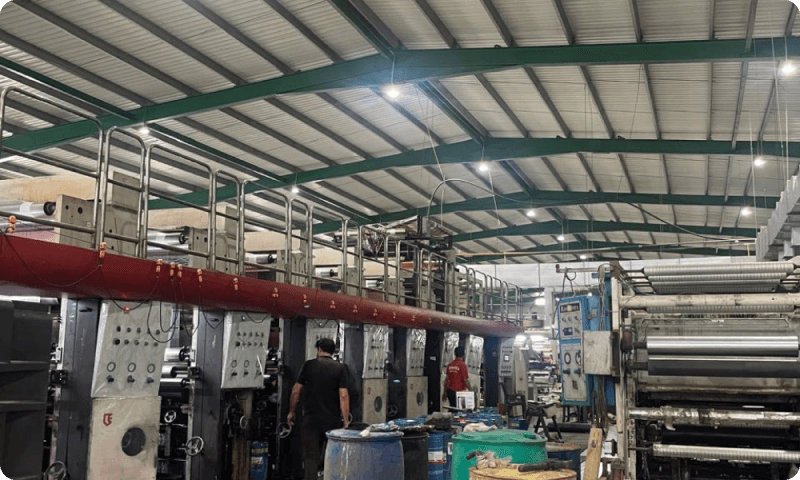
FSSAI emphasizes Good Manufacturing Practices (GMP) — clean environments, segregated printing areas, and zero solvent residue (especially for solventless lamination). Regular audits and employee hygiene checks strengthen compliance credibility.
6. Labeling and Export Documentation
Ensure that labeling meets both FSSAI and importing-country labeling standards — including manufacturer details, batch codes, expiry, and country of origin. Maintain digital records of CoA (Certificate of Analysis) and MoU with NABL labs for faster export audits.
✍️ Conclusion
Complying with FSSAI norms is not just a box to tick — it’s a trust signal for your buyers.
A clean compliance record improves export readiness, brand credibility, and access to high-value international markets.
Performance That Scales With You
Built for Operational Demands, Backed by Measurable Results
From fast-growing exporters to legacy FMCG brands, our flexible packaging solutions help clients reduce operational risk, improve supply chain speed, and scale with confidence.
₹150 Cr+
Annual Packaging Supplied
20+ Years
Industry Experience
500+
95%+
Repeat Order Rate
Ready to Elevate Your Packaging Supply Chain?
From stretch film to custom laminates, we’re built to support your scale.
Mukund Industries
Packaging engineered for performance, trusted for over 20 years.
Technologies
Get in Touch
Certifications
© 2025 Mukand Industries Pvt. Ltd. All rights reserved.